
For global gemstone distributors, industrial jewelry manufacturers, and high-end lapidary procurement managers, material scrap rates directly dictate the bottom line of production profitability. Premium minerals such as jadeite, nephrite, and various precious gemstones possess complex, delicate crystalline lattices that are highly susceptible to subterranean structural damage during mechanical processing. During the intricate phases of deep-hollow profiling, undercutting, and fine filigree detailing, a single micro-fracture propagated by erratic tool behavior can instantly ruin an irreplaceable, high-value workpiece.
Within the industrial carving and lapidary production sectors, there remains a persistent technical misconception that operating at lower rotational speeds is a safer method to mitigate material cracking. In reality, modern mineralogical engineering and kinematics demonstrate that insufficient rotational velocity, paired with weak motor torque dynamics, is the primary catalyst for structural material failure. Sourcing heavy-duty rotary equipment capable of delivering high velocity alongside massive torque continuity is paramount for protecting raw inventory investments. This technical analysis explores the underlying mechanical physics of mineral carving and highlights why a true 50,000 RPM speed ceiling and an 8.0 N.cm torque capacity represent the ultimate defense against structural cracking.
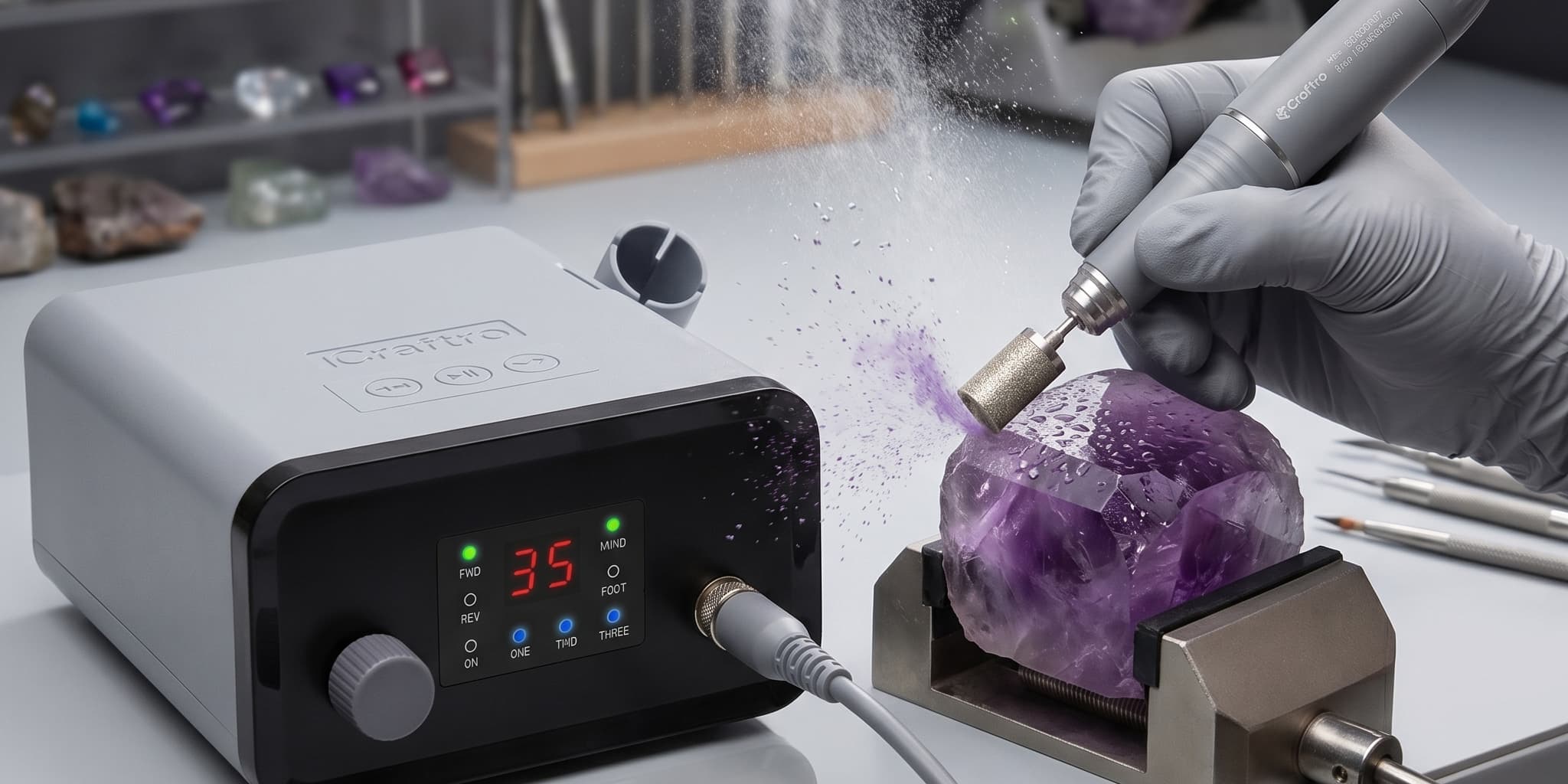
1. The Mechanical Root of Gemstone Cracking: Micro-Stuttering vs. Heavy-Duty Torque
Gemstones and structural jades exhibit unique Mohs hardness ratings, anisotropic density distributions, and distinct cleavage planes. When a rotating abrasive carving bit or grinding head encounters a high-density quartz inclusion or an irregular mineral vein within the stone, the material exerts an immediate resistance force against the cutting tool. If the carving machinery relies on a standard, low-torque motor system, the rotational velocity will plunge drastically upon contact with this increased load.
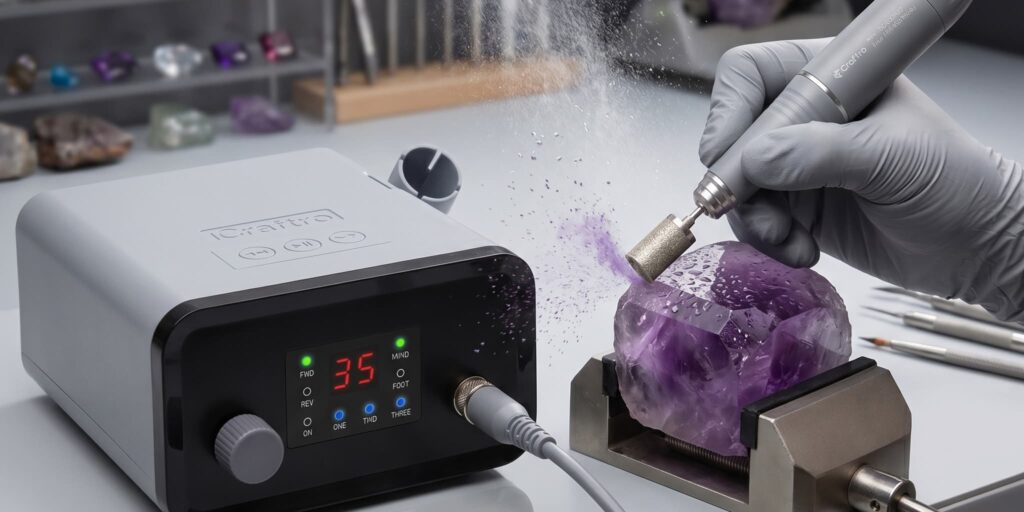
This abrupt drop in speed induces severe mechanical micro-stuttering. In terms of kinetics, this micro-stuttering acts as a high-frequency miniature jackhammer, sending violent physical shockwaves directly along the gemstone’s natural cleavage planes and forcing micro-cracks to split into catastrophic fractures. To eliminate this operational hazard, industrial carving operations require extensive torque headroom. An advanced brushless system engineered to deliver a massive, continuous 8.0 N.cm torque output guarantees that the grinding head maintains an absolute, unyielding rotational velocity under variable load profiles, cleanly slicing through dense crystalline boundaries without a single millisecond of stalling or mechanical hesitation.
2. Thermal Shock Elimination: How 50,000 RPM Suppresses Heat Accumulation
When a rotary carving tool operates with insufficient speed or inadequate torque capability, the abrasive bit remains localized in contact with a specific zone of the mineral lattice for an extended duration. To compensate for the decelerating rotation and lack of cutting efficiency, the artisan is naturally forced to apply heavy manual downward pressure against the workpiece. This combination of prolonged tool contact and excessive physical force generates intense, localized frictional heat within seconds.
Because minerals have low thermal conductivity, this concentrated energy produces an aggressive temperature spike. The immediate surface layer of the stone expands rapidly while the interior core remains cool, triggering extreme internal thermal shock stress that shatters the stone instantly. Elevating the operational capacity to a true 50,000 RPM fundamentally alters this thermodynamic equation. At ultra-high velocities, individual diamond abrasive particles pass across the mineral surface with maximum frequency. The grinding tool removes material so rapidly and cleanly that the physical contact time per rotation is minimized, dissipating kinetic energy into the airborne dust and completely suppressing destructive thermal stress at the source.
| Technical Parameter | Low-Tier Equipment (Standard Brushed Motors) | Premium Heavy-Duty System (VK-MM2 Benchmark) |
|---|---|---|
| Rotational Velocity Ceiling | Typically restricted to 20,000–35,000 RPM. Grinding bits pass too slowly across heterogeneous crystal matrices, lingering on the surface and increasing dwell time. | Reaches an ultra-high 50,000 RPM capacity. Rapid passage ensures micro-clean abrasive action and flawless surface finishes. |
| Torque Continuity under Load | Weak torque performance (often under 3.5 N.cm). Stalls, shifts, or bogs down instantly when encountering dense mineral inclusions or tough crystalline knots. | Delivers an immense, uninterrupted 8.0 N.cm torque. Effortlessly cuts through fluctuating mineral densities without losing RPM. |
| Operator Manual Force | Requires constant downward manual pressure from the artisan, introducing physical instability, fatigue, and uneven directional stress vectors. | Demands zero manual force. The high-torque motor does the mechanical work, allowing the bit to glide organically through the mineral lattice. |
| Radial Runout & Vibration | Substantial shaft eccentricity and micro-wobble transmit harsh physical concussions directly into vulnerable gemstone cleavage lines. | Ultra-low vibration via calibrated bearing alignment, ensuring the diamond bit remains perfectly concentric for microscopic accuracy. |
| Thermal Shock & Scrap Risk | High localized heat accumulation leads to aggressive thermal expansion, resulting in frequent micro-fractures and costly material scrap. | Optimized heat dissipation and swift, cool cutting action eliminate thermal shocks, reducing raw material breakage rates to absolute zero. |
3. Eradicating Radial Runout to Protect Structural Cleavage Planes
In high-velocity precision manufacturing, any minute deviation in the geometric alignment of the rotary shaft core results in radial runout—the horizontal wobbling of the active grinding head. At high rotational velocities, even a microscopic runout profile acts like a micro-jackhammer, striking the crystalline matrix of the mineral tens of thousands of times per minute. For gemstones possessing sensitive cleavage orientations, such as fine jadeite or complex beryls, this chaotic physical percussion forces structural interfaces to delaminate, causing instantaneous macroscopic fractures.
To eliminate this physical hazard, high-speed micromotors must maintain pristine internal mechanical stability. Premium hardware achieves this by incorporating specialized, high-rigidity internal components and a reinforced three-lobe spring chuck mechanism calibrated to strict international guidelines. This rigorous structural configuration locks the grinding shank into perfect concentric alignment, providing a seamless, vibration-free rotation that treats fragile crystalline formations with the utmost mechanical safety.
4. The Commercial Edge: Accelerating Production Yield and Throughput
For large-scale industrial jewelry workshops, processing centers, and global brand manufacturers, minimizing raw material waste is a cornerstone of operational scaling. Operating with underpowered or mechanically unstable rotary tools directly translates to severe financial overhead losses stemming from shattered raw materials and diminished manufacturing velocity. Equipping a commercial processing line with an industrial-grade 50,000 RPM, 8.0 N.cm brushless architecture fundamentally shifts factory capability.
Production artisans can execute complex undercuts, deep-hollow profiling, and fine filigree textures at maximum speed, entirely free from the operational anxiety of the stone fracturing mid-way through a cycle. The integration of elevated cutting velocities and near-zero material breakage parameters allows high-capacity manufacturing operations to optimize their material yield, shorten lead times, and seamlessly fulfill volume-heavy international corporate orders.
Technical Spotlight: The VK-MM2 Heavy-Duty Brushless Micromotor
For global procurement executives, brand managers, and B2B distributors seeking to optimize industrial carving infrastructure, the VK-MM2 Brushless Micromotor represents the absolute zenith of premium mechanical engineering. Engineered specifically to withstand the unforgiving tensile stresses of dense mineral carvings, advanced ceramics, and high-precision technical materials, the VK-MM2 establishes a new benchmark for commercial performance.
- Industrial 50,000 RPM Capabilities: Provides commercial processing lines with a vast operational speed spectrum, facilitating rapid bulk material removal and intricate detailing.
- Massive 8.0 N.cm Torque Threshold: Engineered to deliver unwavering torque continuity. The VK-MM2 maintains steady speed parameters and resists stalling under severe material resistance.
- Advanced Brushless Engineering: Employs electronic commutators and strong magnetic fields, eliminating physical carbon brushes. This design ensures zero carbon dust contamination, whisper-quiet operation, and a lifespan exceeding 5,000 industrial hours.
- Intelligent Microprocessor Safeguards: Features integrated digital microprocessors providing real-time Over-Current monitoring and automated Over-Temperature shutdown protocols to safeguard internal components against prolonged high-load wear.
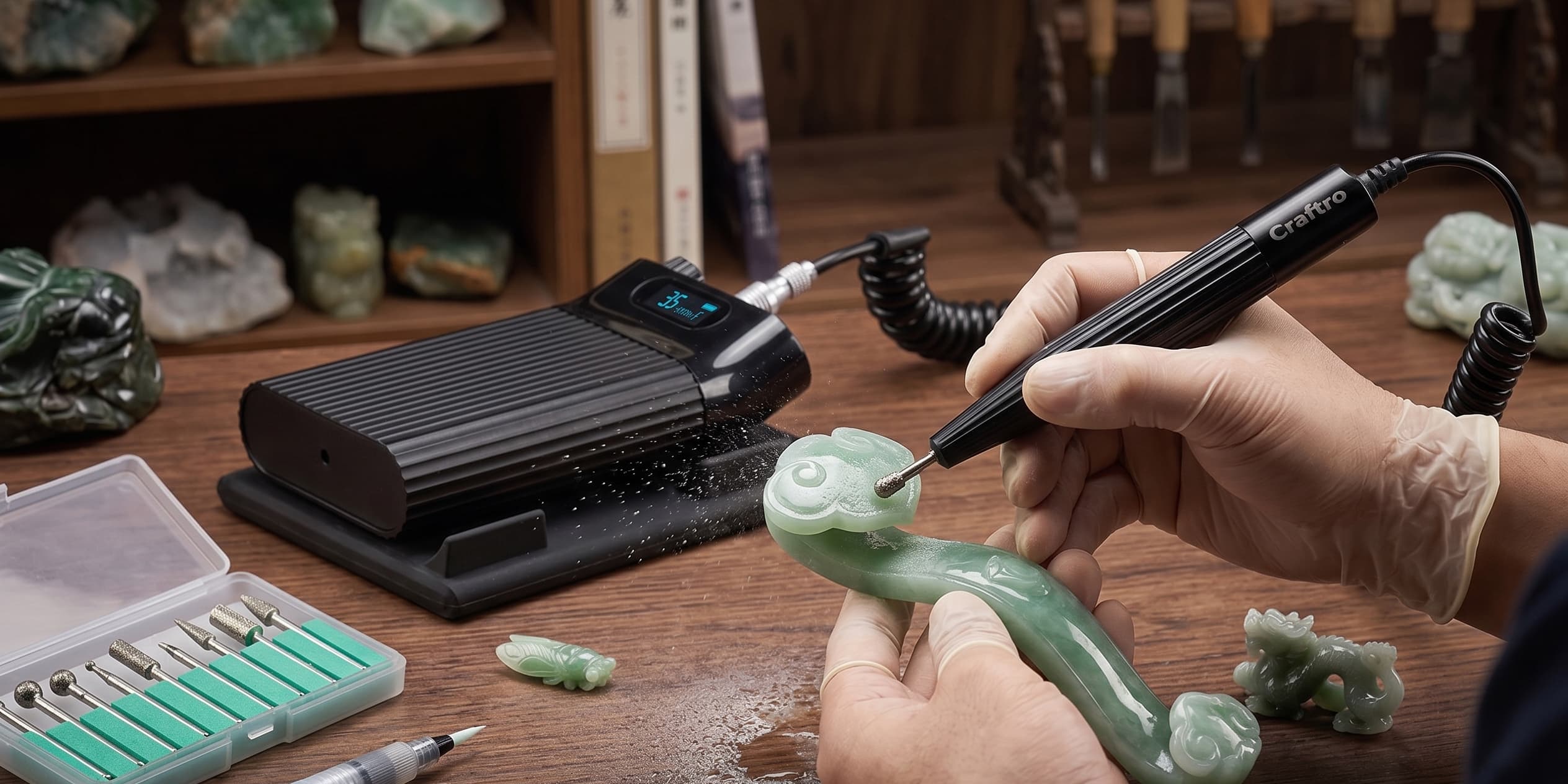
FAQ
Why is torque continuity more critical than maximum speed when processing raw jadeite?
A: High operational speed is essential for clean material removal, but torque continuity is what keeps the grinding bit spinning when it encounters dense iron or chromium inclusions within raw jadeite. If a micromotor lacks torque headroom, its speed drops instantly under load, causing sudden mechanical stuttering. It is this sudden physical deceleration and micro-stuttering—not high velocity—that delivers the destructive kinetic force that fractures a stone’s crystalline structure.
How does the 8.0 N.cm torque threshold of the VK-MM2 alleviate operator hand fatigue?
A: With standard low-torque rotary systems, operators must apply significant manual force to push the slowing bit through tougher mineral layers. This constant muscle strain causes hand tremors, accelerated fatigue, and directional errors. The VK-MM2’s massive 8.0 N.cm torque performs all heavy cutting work mechanically; the technician simply guides the handpiece with minimal pressure, preserving geometric accuracy and protecting long-term musculoskeletal health.
Does operating a micromotor at 50,000 RPM necessitate specialized grinding heads or bits?
A: Yes, absolutely. At velocities as high as 50,000 rotations per minute, any minute bending or manufacturing eccentricity in a low-grade bit shank will amplify into dangerous runout and rapidly destroy the high-speed bearings. Industrial operations must utilize premium, balanced diamond grinding tools strictly calibrated to the international standard 2.35mm shank diameter, ensuring absolute concentricity and smooth performance.
What is the recommended maintenance protocol for a 50,000 RPM brushless handpiece in a dusty factory setting?
A: Unlike traditional brushed motors, brushless internals generate zero carbon dust internally. However, high-volume mineral dust from the carving process must be cleared away from the front nosepiece daily using dry compressed air. The external housing should be wiped clean with a dry cloth or one slightly moistened with alcohol. Never submerge the handpiece or spray liquid disinfectants directly into the seams, as moisture can compromise the internal high-precision bearings and electronic speed sensors.
As you can see
Preventing jade and gemstone cracking during high-velocity carving processes is achieved by balancing extreme velocity with stable, unyielding torque. Relying on sub-par, low-torque hardware invites catastrophic motor stalls, erratic shaft vibrations, and excessive friction heat—the foundational drivers of structural material cleavage. Investing in advanced systems engineered to a true 50,000 RPM velocity threshold and an 8.0 N.cm torque continuity benchmark ensures that industrial processing facilities operate with maximum material yield, immaculate aesthetic quality, and unparalleled commercial throughput.
Partner with Shanghai Craftro Tech Co., Ltd.
We manufacture state-of-the-art, high-tech grinding equipment and brushless micro-motors engineered precisely to global gold standards. We offer comprehensive, flexible OEM/ODM solutions—including custom housing colors, personalized packaging, and custom logo printing—backed by an integrated digital supply chain and modern manufacturing facilities certified under ISO9001, ISO13485, MDSAP, and registered with the U.S. FDA.
For bulk wholesale inquiries, custom branding partnerships, or to receive our latest high-end product catalog, contact our B2B operations team directly at: info@craftrotech.com.